
You’ve probably said “I hope” more times than you can count. “I hope you’re well.” “I hope this works out.” “I hope it doesn’t rain.” It’s a tiny phrase that carries a lot of emotional weight, yet most people lean on it so often that their writing starts to feel a bit flat.
Here’s why that matters. The words you choose shape how confident, warm, or polished your message sounds. A business email loaded with “I hope” five times in a row reads like a rough draft, not a finished piece. Switching things up, on the other hand, makes your writing sound thoughtful and intentional.
Quick comparison: Formal — “It is my sincere wish that the project proceeds smoothly.” Informal — “Fingers crossed it all works out!” Same feeling, totally different vibe.
Let’s break down everything you need to know about “I hope” and the many ways to express that same idea with more color and precision.
What Does “I Hope” Mean?
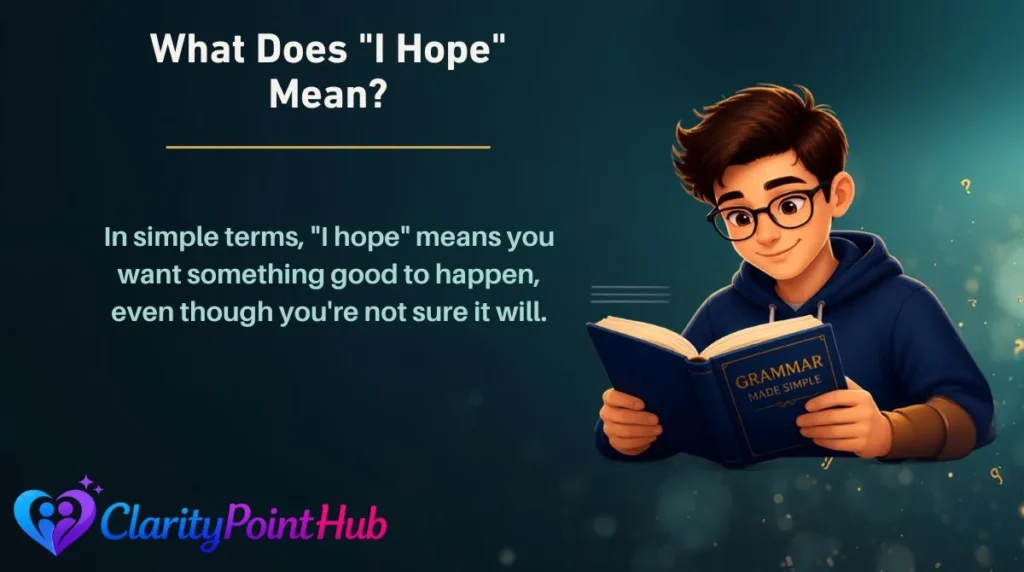
In simple terms, “I hope” means you want something good to happen, even though you’re not sure it will. It’s wishful, optimistic, and forward-looking.
Grammar form: “Hope” works as a verb here (“I hope that…”), though it can also function as a noun (“I have hope”). It’s often followed by a clause starting with “that,” though “that” gets dropped in casual speech.
Synonyms include wish, trust, expect, and anticipate. The opposite tone would be something like “I doubt” or “I’m afraid,” which signals worry instead of optimism.
Sample sentences:
- “I hope you enjoy the trip.”
- “I hope the meeting goes smoothly tomorrow.”
When to Use “I Hope”

This phrase shows up everywhere, but the tone shifts depending on where you use it.
Spoken English: Extremely common. People say it constantly in casual conversation without a second thought.
Business English: Used often, though overuse can weaken your authority. Phrases like “I trust” or “I’m confident” sometimes land better in professional contexts.
Emails and Messages: A staple opener and closer. “I hope you had a great weekend” or “I hope to hear from you soon” are everyday email lines.
Social Media: Frequently shortened to “Hope you’re good!” or used in captions like “Hoping for sunny skies this weekend.”
Academic Writing: Mostly avoided. Academic tone favors more neutral language like “It is anticipated that…” instead of personal hope.
Professional Meetings: Common when discussing outcomes — “I hope we can finalize this by Friday” sounds natural and collaborative.
Is “I Hope” Polite or Professional?
“I hope” sits in a flexible, friendly zone. It’s rarely offensive, though it can sometimes sound uncertain if overused in high-stakes business writing.
- Polite: Yes, it’s a gentle, courteous phrase.
- Neutral: Mostly neutral, leaning warm.
- Strong: No, it lacks force or certainty.
- Soft: Very soft and non-demanding.
- Formal vs Informal: Works in both, though formal writing often swaps it for “trust” or “anticipate.”
Pros & Cons of Using “I Hope”
✔ Pros:
- Sounds warm and approachable
- Universally understood, even by beginners
- Softens requests and expectations
- Works in nearly any setting
- Easy to pair with other phrases naturally
✘ Cons:
- Overused, so it can sound generic
- Can weaken confident statements in business writing
- Repetition makes essays and emails feel repetitive
- Sometimes too soft for formal recommendations or proposals
- Doesn’t convey certainty when certainty is needed
Below is a full lineup of strong alternatives, broken down so you know exactly how and when to use each one.
1. I Trust That
Meaning: A more confident way to express hope, implying you expect a good outcome. Explanation: “Trust” carries more certainty than “hope.” It signals that you believe something will happen, not just that you wish it would, which gives your writing a more assured tone. Grammar Note: Formal verb phrase. Example Sentence: “I trust that the shipment will arrive on schedule.” Best Use: Formal emails, business reports, client communication. Worst Use: Casual texting — sounds stiff among friends. Tone: Formal, Strong. Level: Advanced. Similarity Score: 7/10. Replaceability Tip: Use when you want to sound confident rather than uncertain.
2. I’m Hoping For
Meaning: A slightly more casual, ongoing version of “I hope.” Explanation: This phrase feels conversational and present-focused. It works well when describing something you’re actively wishing for right now, rather than a general wish. Grammar Note: Present continuous verb phrase. Example Sentence: “I’m hoping for good weather this weekend.” Best Use: Casual conversation, texts, informal emails. Worst Use: Formal academic writing. Tone: Friendly, Neutral. Level: Beginner. Similarity Score: 9/10. Replaceability Tip: Great everyday swap when “I hope” feels too repetitive.
3. Fingers Crossed
Meaning: An informal idiom meaning you hope something good happens. Explanation: This playful idiom comes from the old gesture of crossing fingers for luck. It adds personality and humor, making it perfect for light, casual exchanges. Grammar Note: Idiom, often standalone. Example Sentence: “Fingers crossed the interview goes well tomorrow!” Best Use: Texts, social media, casual chats with friends. Worst Use: Formal emails or professional presentations. Tone: Playful, Soft. Level: Beginner. Similarity Score: 6/10. Replaceability Tip: Use only in relaxed, informal settings.
4. It Is My Hope That
Meaning: A formal, slightly old-fashioned way of stating a wish. Explanation: This structure adds weight and formality, often appearing in speeches, official letters, or ceremonial writing where a more elevated tone fits. Grammar Note: Formal noun phrase construction. Example Sentence: “It is my hope that this agreement benefits both parties.” Best Use: Speeches, formal letters, official statements. Worst Use: Daily conversation — sounds overly grand. Tone: Formal, Strong. Level: Advanced. Similarity Score: 8/10. Replaceability Tip: Save this for ceremonial or highly formal writing.
5. I Look Forward To
Meaning: Expresses a hopeful, positive expectation about something upcoming. Explanation: While not identical in meaning, this phrase captures the optimistic energy behind “I hope,” especially when discussing future events or outcomes. Grammar Note: Formal phrasal verb. Example Sentence: “I look forward to hearing your decision.” Best Use: Professional emails, job applications, business closings. Worst Use: Expressing hope about uncertain or risky outcomes. Tone: Professional, Neutral. Level: Intermediate. Similarity Score: 6/10. Replaceability Tip: Best for confident anticipation, not uncertain wishes.
6. I Wish
Meaning: A more emotional, sometimes wistful way to express a desire. Explanation: “Wish” often implies something less likely or slightly out of reach, giving it a softer, more sentimental feel than “hope.” Grammar Note: Verb, often followed by a past-tense clause. Example Sentence: “I wish you the best of luck on your exam.” Best Use: Personal messages, greeting cards, casual conversation. Worst Use: Business proposals needing confident language. Tone: Soft, Friendly. Level: Beginner. Similarity Score: 7/10. Replaceability Tip: Choose this for warmth and sentiment over certainty.
7. I Anticipate
Meaning: A formal way to express expectation, often used instead of hope in professional settings. Explanation: This word leans analytical and confident, suggesting you’ve thought ahead rather than simply wishing for an outcome. Grammar Note: Formal verb. Example Sentence: “I anticipate a strong turnout for the conference.” Best Use: Business reports, forecasts, academic writing. Worst Use: Casual personal conversations — sounds too clinical. Tone: Formal, Neutral. Level: Advanced. Similarity Score: 5/10. Replaceability Tip: Use when discussing predictions rather than personal wishes.
Mini Dialogue Examples
Formal Dialogue
Person A: “I trust that the revised contract meets your expectations.” Person B: “It does, thank you. We’re pleased with the changes.”
Informal Dialogue
Person A: “Fingers crossed the team wins tonight!” Person B: “Same here, it’s been a rough season so far.”
Business Email-Style Example
Subject: Project Timeline Update
Hi Tom,
I’m hoping for a smoother rollout this time around, given the changes we made last sprint. I look forward to reviewing the results with you on Thursday.
Talk soon, Alina
Mistakes to Avoid
- Overusing “I hope” in one paragraph. Repeating it three times in a short email feels clumsy and weak.
- Using “fingers crossed” in formal writing. It instantly breaks a professional tone.
- Confusing “hope” with “wish” in grammar structure. “I wish” typically pairs with past tense, while “I hope” uses present or future forms.
- Sounding uncertain when confidence is needed. Swapping “I hope” for “I trust” or “I’m confident” strengthens business writing.
- Translating directly from another language. Some learners write “I hope so that,” which isn’t correct English structure.
- Forgetting context matching. Using “it is my hope that” in a text message feels oddly formal and out of place.
- Skipping the verb form correctly. “I hope you doing well” is incorrect; it should be “I hope you are doing well.”
Cultural & Tone Tips
Native speakers use “I hope” so naturally that it barely registers as a deliberate word choice. It’s almost automatic, much like saying “please” or “thanks.”
UK English: Tends to favor slightly more reserved phrasing, such as “I trust” or “I should hope,” especially in professional or written contexts.
US English: Leans casual and direct — “Hoping for the best!” or “Fingers crossed!” pop up constantly in everyday speech and texting.
Casual Social English: Shortened forms dominate online spaces — “hope so!”, “really hoping”, or simply a thumbs-up emoji replacing the whole phrase entirely.
Comparison Table: 7 Best Alternatives
| Phrase | Tone | Best Context | Professional Level | Example |
|---|---|---|---|---|
| I trust that | Formal | Business emails, client letters | High | “I trust that everything is in order.” |
| I’m hoping for | Friendly | Casual chats, informal emails | Low-Medium | “I’m hoping for a quick response.” |
| Fingers crossed | Playful | Texts, social media | Low | “Fingers crossed it works out!” |
| It is my hope that | Formal | Speeches, official letters | High | “It is my hope that we move forward together.” |
| I look forward to | Professional | Job applications, closings | Medium-High | “I look forward to your reply.” |
| I wish | Soft | Personal notes, greetings | Low-Medium | “I wish you a smooth recovery.” |
| I anticipate | Formal | Reports, forecasts | High | “I anticipate strong sales next quarter.” |
Other Ways to Say I Hope in English to Someone
When you want to express hope to someone in a general, everyday way, you don’t always need the word “hope” at all. Try phrases like “I’m wishing you,” “Here’s hoping,” or “Fingers crossed that.” For example, instead of “I hope you get the job,” you could say “Fingers crossed you get the job” or “I’m rooting for you to get the job.” These alternatives carry the same warmth but sound less repetitive, especially if you’ve already used “hope” earlier in the conversation.
Other solid options include “I trust that,” “I’m confident that,” and “With any luck.” Each one shifts the tone slightly. “I trust that things will work out” feels calm and reassuring, while “With any luck, everything will fall into place” feels a bit more casual and light. Choosing the right one depends on how close you are to the person and how serious the situation is.
Other Ways to Say I Hope in English to a Friend
Conversations with friends usually call for something more relaxed than formal alternatives. Instead of “I hope you feel better soon,” you might say “Sending good vibes your way” or “Rooting for you to feel better.” These phrases sound like something you’d actually text a close friend rather than something pulled from a textbook.
You can also try “I’m crossing my fingers for you,” “I’ve got a good feeling about this,” or simply “You’ve got this.” None of these use the word “hope,” yet they all express the same supportive intention. If your friend is going through something tough, “I’m thinking of you and hoping things turn around” can be softened into “I’m thinking of you, and I know things will turn around.” That small shift from hope to confidence can feel more comforting in the moment.
Another Word for I Hope in an Essay
Academic and formal writing calls for a different set of tools than everyday speech. Repeating “I hope” in an essay can make your writing sound less confident and less polished, so it’s worth swapping it out depending on the point you’re making. If you’re expressing an expectation, try “It is anticipated that,” “It is expected that,” or “This suggests that.” For example, “I hope this research will contribute to the field” becomes “This research is expected to contribute meaningfully to the field,” which reads as more objective and academic.
If you’re expressing a desired outcome rather than a prediction, phrases like “It would be beneficial if,” “Ideally,” or “The intention is that” work well. For instance, “I hope future studies will address this gap” could become “Ideally, future studies will address this gap” or “It is intended that future research will address this gap.” These alternatives keep your writing formal while still conveying the same underlying hope for a positive result.
Another Way to Say I Hope You Had a Good Day
This is one of the most common phrases people want to switch up, since it gets used so often in texts, emails, and casual chats. A few natural alternatives include “I hope your day went well,” “I trust you had a great day,” and “Here’s hoping your day treated you well.” If you want to skip the word “hope” entirely, try “I bet you had a good day” or “Sounds like it was a good day” if you already know a bit about how their day went.
For a warmer, more personal touch, you could say “I hope today was kind to you” or “I hope today gave you something good.” These versions feel a little more thoughtful than the standard phrase and can make a simple check-in message feel more genuine, especially with someone you care about.
What to Say Instead of I Hope You
When you’re speaking directly to someone, there are many ways to rework this common structure. Instead of “I hope you succeed,” you could say “I know you’ll succeed,” “I believe in you,” or “You’re going to do great.” These alternatives replace hope with confidence, which can feel more encouraging, especially before something important like an interview, exam, or presentation.
Other useful swaps include “Wishing you,” “May you,” and “All the best with.” For example, “I hope you enjoy your trip” becomes “Wishing you an amazing trip” or “May your trip be everything you’re looking forward to.” These phrasings are especially common in cards, messages, and speeches, where a slightly more expressive tone fits the occasion.
Another Word for Hope Professionally
In professional communication, tone matters just as much as content. Overusing “I hope” in emails or reports can come across as uncertain, so many professionals reach for more assertive alternatives. Instead of “I hope this proposal meets your expectations,” you might write “I trust this proposal meets your expectations” or “This proposal has been designed to meet your expectations.” Both versions sound more confident without losing politeness.
Other professional alternatives include “It is our expectation that,” “We anticipate that,” and “We are confident that.” For example, “I hope we can move forward with this partnership” could become “We are confident this partnership will move forward successfully.” These phrases are especially useful in business emails, proposals, and reports where a more authoritative tone builds trust with clients or colleagues.
Another Way to Say Hopefully
“Hopefully” is another word that tends to get overused, and thankfully, there are several natural substitutes. Depending on the context, you can use “With any luck,” “All being well,” “Ideally,” or “God willing,” the last of which is common in more personal or informal contexts. For example, “Hopefully, the weather will clear up” could become “With any luck, the weather will clear up” or “All being well, the weather should clear up.”
In more formal writing, “It is hoped that,” “Presumably,” or “In the best-case scenario” can work well too. For instance, “Hopefully, the results will be positive” might become “In the best-case scenario, the results will be positive.” Choosing the right alternative depends on whether you want to sound casual, formal, or somewhere in between.
I Hope Synonym Email
Emails often repeat the same handful of phrases, especially at the beginning or end of a message, so having alternatives on hand can make your writing feel fresher. Common email openers like “I hope this email finds you well” can be replaced with “I trust this message reaches you well,” “I hope you’re doing well,” or the more modern and slightly informal “Hope you’re having a good week.”
For closing lines, instead of “I hope to hear from you soon,” try “Looking forward to your response,” “I look forward to hearing from you,” or “Please let me know your thoughts when you get a chance.” These alternatives keep your email polite and professional while avoiding the repetition that comes from using “hope” in nearly every message you send. Small changes like these can make your writing feel more intentional and less like it was written on autopilot.
In the end, “I hope” is a perfectly good phrase, but English gives you dozens of ways to express the same sentiment with more nuance. Whether you’re texting a friend, writing an essay, or sending a professional email, choosing the right alternative can make your message feel more genuine, more confident, and more suited to the moment.
Frequently Asked Questions
What can I say instead of “I hope”?
You can say “I trust,” “I am confident,” or “I anticipate” for a more professional tone.
How do you say hope in a fancy way?
“Aspire,” “anticipate with confidence,” or the more formal “I am hopeful that” all elevate the phrasing.
What is another word for “I hope”?
“Trust,” “expect,” or “anticipate” serve as strong alternatives depending on context.
What is a stronger word for hope?
“Confide,” “aspire,” or “aspiration” convey a firmer sense of expectation than a simple hope.
What can I say instead of hoping?
“Anticipating,” “trusting,” or “looking forward to” work well as substitutes in professional writing.
What is an old fashioned word for hope?
“Aspiration,” “expectancy,” or the archaic “wistfulness” carry a more traditional, literary tone.
Conclusion
Small words carry big influence over how your message lands. Relying on “I hope” for every wish or expectation limits your range and makes your writing predictable. By mixing in alternatives like “I trust,” “fingers crossed,” or “I anticipate,” you’ll sound more natural, more confident, and far more fluent. Try using a different version each time you write an email or text this week. The more you practice swapping phrases, the more these alternatives will start to feel like second nature.

Saqlain Ali is the founder and lead content strategist at ClarityPointHub.com, where he helps writers, students, and professionals improve their grammar, sentence clarity, and overall writing quality. With hands-on experience in content writing, editing, and language tools, Saqlain is passionate about making clear communication accessible to everyone.